
Thinking in Bets (Annie Duke)
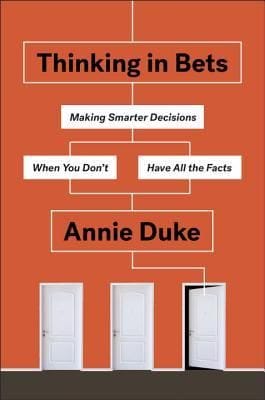
Annie Duke argues that decision-making is more like poker than chess. In poker, you make choices with incomplete information, uncertainty, and luck involved. The goal is not to make perfect decisions, but to make the best decisions possible with the information available.
1. Accept Uncertainty
Good decisions don’t guarantee good outcomes, and bad outcomes don’t always mean the decision was wrong. Luck plays a role. Focus on the quality of your decision-making process rather than the result alone.
2. Treat Decisions as Bets
Every decision is a bet on a future outcome. Since our beliefs and biases influence those bets, we should strive to be as objective as possible and recognize the opportunity costs of every choice.
3. Create a Learning Loop
Use feedback to improve future decisions. Continuously update your beliefs when new information becomes available and stay open to alternative explanations.
4. Use a “Buddy System”
Other people can help identify blind spots and challenge assumptions. Seek out diverse perspectives and prioritize accuracy over being right.
5. Stay Skeptical
Question your assumptions and confidence levels. Good decision-makers are willing to examine what they know, what they don’t know, and where they might be wrong.
6. Use Time-Travel Techniques
Duke recommends four tools for making better long-term decisions:
10-10-10: Consider the consequences of a decision in 10 minutes, 10 months, and 10 years.
Reconnaissance: Explore multiple possible futures and estimate the likelihood of each.
Backcasting: Imagine you’ve achieved your goal and work backward to identify how you got there.
Premortem: Imagine you’ve failed and identify the reasons why, so you can address risks before they happen.
Key Takeaway:
The best decision-makers don’t try to predict the future perfectly. They accept uncertainty, think in probabilities, seek objective feedback, and continuously learn from outcomes. Over time, this leads to smarter decisions and better results.
a month ago
Comments




Follow Ashlie
By submitting, you agree to our Terms and Privacy Policy